
When Finance Sees Everything Earlier: What AI Does to Unclaimed Property Compliance 🤖
By Josiah S. Osibodu, CPA, CFE, Certified AI Consultant | 5-minute read
AI unclaimed property compliance earlier awareness is not a technology story. It is a timing story. For decades, compliance has operated with a built-in delay. A check goes uncashed. A credit stays unresolved. A vendor balance ages. A refund is never claimed. Months — sometimes years — later, someone in tax or finance starts asking whether those balances are reportable. That delay has grown so familiar that most companies no longer question the model behind it.
AI may force that question. Consequently, the answer could change the economics of compliance entirely.
How AI Unclaimed Property Compliance Earlier Awareness Changes the Game 🔄
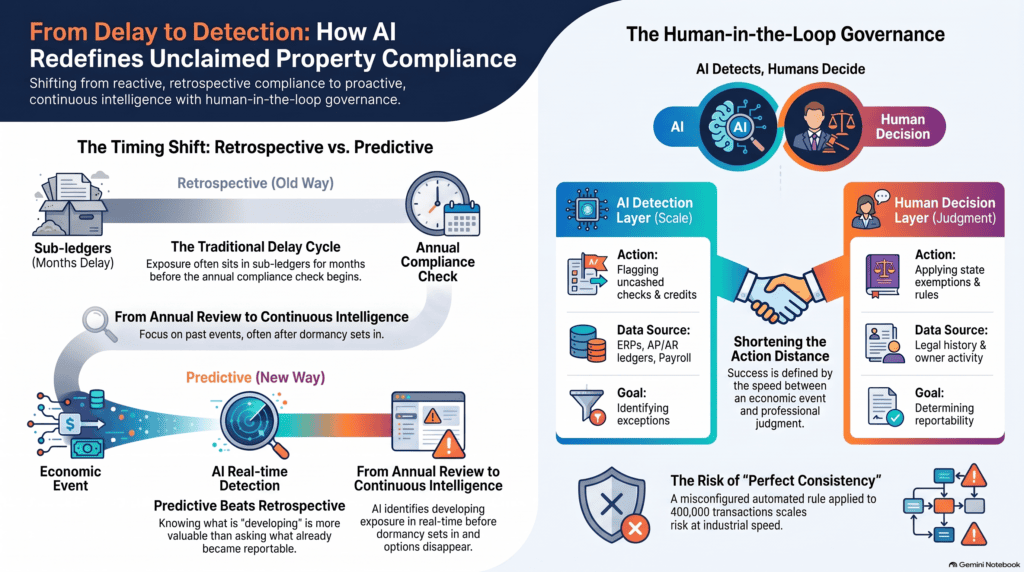
The simple version: AI shortens the distance between when something happens and when management knows about it. The technical detail is more specific. Traditional compliance runs on a periodic cycle:
Transaction → Aging → Dormancy → Annual Review → Due Diligence → Report
Nothing is wrong with that sequence. The problem is what happens between each step. Potential exposure sits across ERP systems, payroll platforms, AP sub-ledgers, AR records, acquisition entities, and legacy files for months before anyone reviews it. Consequently, by the time compliance begins its annual check, many items have already aged past the point where proactive options exist.
AI changes the timing. A check stays outstanding past 30 days. Flag it. A customer credit sits unresolved. Flag it. A balance moves through an unusual account. Flag it. A write-off clears a population of old credits. Investigate it. The business impact follows directly. Management learns about developing exposure while options still exist — not after dormancy has set in and the state has already identified the gap.
The Distinction That Protects This Model ⚖️
AI does not decide whether a transaction is reportable property. That distinction matters more than any other point in this discussion. Deciding reportability requires knowledge of the transaction, the owner’s activity, the applicable dormancy period, state rules, exemptions, and legal history. No detection system can apply that judgment reliably. Therefore, the right model keeps AI in the detection layer and humans in the decision layer:
Data → AI Detection → Exception → Human Review → Decision → Records → Learning
That workflow is both more accurate and more defensible than the alternative — because the professional’s judgment is documented, and that record feeds back into the next detection cycle.
From Periodic Reporting to Continuous Intelligence 🔎
This shift changes the operating model in a way that goes beyond efficiency. Traditional compliance asks: “What became reportable?” That is a retrospective question. AI-assisted detection asks: “What is developing inside the organization that could become reportable?” Consequently, that is a predictive one — and predictive beats retrospective in every material way.
Consider the practical scope of what continuous detection can monitor:
- Aging customer credits and unresolved AR balances
- Uncashed checks and stale disbursements
- Vendor credits sitting past dormancy thresholds
- Payroll items that never cleared
- Suspense account balances with no resolution pathway
- Write-offs that reclassified owner obligations without due diligence
- Entity gaps created by acquisitions or ERP conversions
AI does not need to evaluate all of these for legal reportability. It needs to identify which ones deserve professional attention. Consequently, that narrower role is both safer and more scalable than asking a system to make legal determinations independently.
The Write-Off Problem Gets Harder to Ignore ⚠️
Here is where AI creates risk as well as benefit. An automated finance system encounters thousands of stale credits. Its goal is a clean ledger. So it reclassifies old balances, sweeps unresolved items, and books them to income. From an accounting view, the workflow looks clean. From an unclaimed property view, it may have destroyed evidence of obligations owed to owners.
Consequently, finance automation without compliance logic embedded can accelerate risk faster than manual processes ever could. A poorly configured rule applied across 400,000 transactions with perfect consistency is more dangerous than the same error applied to 40.
Therefore, the CFO’s question should not only be: “What can we automate?” It should also be: “Which automated decisions could affect an owner’s property rights or our ability to prove what happened?”
That question covers write-offs, sweeps, account closures, credit reclassifications, data deletions, and ledger cleanup events. Each one deserves a compliance check before it runs — not after.
The Governance Chain That Makes This Work 🛡️
AI can scale good methodology. It can also scale bad methodology at industrial speed. Suppose a dormancy rule is wrong. A state changes its reading. A property class is misclassified. An exemption is outdated. If a detection system encodes that error and runs it across millions of transactions, the result is not a small mistake — it is a consistent, documented pattern of the same mistake.
That is why the full governance chain must stay intact:
Law → Policy → Control → AI Workflow → Human Decision
When the law changes, every link below it needs review. Therefore, someone must own that chain — not as a review sign-off, but as full accountability for the output at every stage. AI does not reduce that ownership need. It raises the stakes of getting it wrong.
What This Means for the Compliance Function 🎯
The compliance professional of the future does not compete with detection systems. They manage what detection systems cannot: meaning, judgment, context, and defensibility. Machines manage scale. Professionals manage meaning. The strongest practitioners will know what the system should flag, what a flagged item actually means legally, when a pattern represents a reportable population versus an accounting artifact, and when leadership needs to act before the state answers the question instead.
Consequently, genuine unclaimed property expertise becomes more valuable in an AI-assisted setting — not less. The detection layer removes the work that never required expertise. What remains is exactly the work that always did.
Shortening the Action Distance ⚡
Success in AI-assisted compliance is not measured by how many transactions get reviewed. It is measured by the speed between an economic event and professional judgment. That is the action distance. And shortening it is the single most valuable thing AI brings to unclaimed property compliance.
When the distance is long — months of aging, annual reviews, delayed discovery — management inherits obligations. Consequently, options have already disappeared by the time anyone asks the right question. When the distance is short — real-time detection, immediate flagging, early professional review — management retains choices. Therefore, the same exposure that would have produced a seven-figure assessment gets resolved before dormancy sets in.
That is not faster compliance. That is better compliance.
The Takeaway
AI unclaimed property compliance earlier awareness does not change what the rules require. It changes when management knows enough to act on them. The winning compliance function will not be the one with the most detection tools. It will be the one that builds the shortest reliable distance between economic event, management understanding, professional judgment, and executive action. Consequently, for unclaimed property, that shortened distance is the difference between discovering an obligation while options exist — and explaining it years later when a state examiner does.
👉 Your Next Step
Before executing your next financial cycle, ledger cleanup, or data migration, determine exactly where your compliance risk stands.
- Free 5-Minute Qualitative Risk Assessment: Get an instant risk score with zero generic advice at EscheatAnalyzer.ai.
- Free 60-Minute Executive Consultation: Schedule a deep-dive session with our specialists at moyerosibodu.com.
❓ FREQUENTLY ASKED QUESTIONS
AI earlier awareness means the gap between when a financial event occurs and when management knows about it shrinks from months or years to days or weeks. Instead of discovering exposure during an annual review or state exam, a detection system flags aging balances, unusual reclassifications, and unresolved credits as they develop. Consequently, management retains the option to act — through owner outreach, voluntary disclosure, or proactive filing — before dormancy removes those choices.
The system applies policy rules to live transaction data across AP, AR, payroll, securities, and legacy records — flagging items that cross defined aging or behavior thresholds for professional review. A stale check gets flagged at 30 days. An unresolved credit gets flagged at 90 days. Consequently, the compliance team reviews only the flagged items — not the full transaction set. That shift expands coverage from a 5% annual sample to the full transaction volume without adding headcount.
Deciding whether property is reportable requires evaluating the specific transaction, the owner’s last activity, the applicable dormancy period, state exemptions, priority rules, and legal history that varies by jurisdiction. No detection system can apply that judgment reliably across 54 reporting jurisdictions. Therefore, the defensible model keeps AI in the detection layer — asking whether an item needs professional review — and keeps licensed professionals in the decision layer. That split produces legally sound output at a scale that manual review cannot match.
When a finance system identifies stale credits and books them to income without a compliance check, it may convert owner obligations into corporate revenue without performing the due diligence state law requires. Consequently, an exam that reviews the write-off account finds the reclassification and treats it as a compliance failure — regardless of whether the underlying accounting was correct. The risk is compounded by scale: an automated rule applied to 400,000 transactions creates 400,000 instances of the same potential error.
The full governance chain must stay intact: Law → Policy → Control → AI Workflow → Human Decision. When any link changes — a state revises its rules, an ERP system changes, a new data source is added — every downstream link needs review. Therefore, one function must own that chain with full accountability for the output at every stage. AI raises the stakes of governance failure because a misconfigured rule scales with the same efficiency as a correct one.
The Escheat Risk Analyzer at EscheatAnalyzer.ai provides a free, 5-minute risk check across four areas — Jurisdictional, Compliance History, Transaction/Revenue, and Operational Complexity. The Compliance History and Operational Complexity areas capture the process maturity factors most relevant to AI-assisted detection readiness. Results arrive instantly, with no cost required and no company name collected.
