
Your AI Is Only as Smart as the Data You Trust 🧠
By Josiah S. Osibodu, CPA, CFE, Certified AI Consultant | 6-minute read
AI data quality in unclaimed property compliance is where most AI strategies quietly fail — not with a dramatic breakdown, but with something quieter and more damaging: confident outputs built on data nobody actually checked.
Companies are racing to put AI on top of their financial data. The problem few executives want to discuss is that AI cannot create visibility from data the enterprise itself cannot trust. If customer credits are misclassified, legacy entities are missing, ERP migrations have broken historical records, or owner information is outdated — AI does not fix any of that. It just moves faster with what is there.
What AI Data Quality In Unclaimed Property Compliance Actually Means 🔎
Here is the thing about AI in finance. Everyone focuses on the tool. Almost nobody asks about what the tool is working with.
The workflow looks straightforward on paper:
Data → AI Analysis → Visibility → Judgment → Decision → Action
Each step builds on the previous one. Consequently, when the first step is reliable — accurate records, consistent classifications, integrated systems, complete historical data — AI genuinely shortens the distance between an economic event and a confident leadership decision. That is the promise, and when the data is clean, it delivers.
But flip the first input and watch what happens:
Bad Data → AI → False Visibility → Bad Decision → Scaled Consequence
The AI does not know the data is wrong. It processes what it receives with complete consistency and no hesitation. Therefore, the misclassified property type does not get caught at 40 transactions — it gets applied to 40,000. The missing subsidiary does not create a small blind spot — it creates a systematic gap in every report the system produces.
That is not an AI failure. It is a data governance failure that AI made impossible to contain.
Why Unclaimed Property Is the Perfect Test Case 🎯
You want to see where data quality problems show up fast? Look at unclaimed property compliance. It is a domain where the underlying data — owner addresses, dormancy dates, property classifications, historical transaction relationships — determines everything.
Get those right and AI produces earlier detection, more accurate filings, reliable dormancy tracking, and timely owner outreach. Get them wrong and the same system produces faster misclassification, missed reportable items, automated write-offs that destroy evidence trails, and audit exposure that compounds silently until a state examiner asks for records the company cannot produce.
Seven Data Problems That Break AI Compliance Systems ⚠️
These are not theoretical. They show up in real compliance programs, often inherited from acquisitions or ERP conversions, and they rarely announce themselves:
- Misclassified property types — the system monitors the wrong category and never flags the right one
- Missing or inaccurate owner information — due diligence cannot be performed on owners the system cannot find
- Incomplete historical transaction records — dormancy calculations break when the baseline is missing
- Entities excluded from the compliance process — acquired subsidiaries that never made it into the monitoring scope
- Data lost during ERP conversions — historical relationships that did not survive the migration intact
- Automated write-offs without compliance review — balance sheet cleanup that created unclaimed property violations at scale
- Incorrect dormancy dates or state rules — the wrong clock running on the right balance
Each of these, on its own, is manageable. Add AI to any one of them, however, and the error scales with the system’s processing speed. Consequently, what would have been a small manual error becomes a documented pattern across thousands of transactions.
The Practical Framework That Actually Works 🛡️
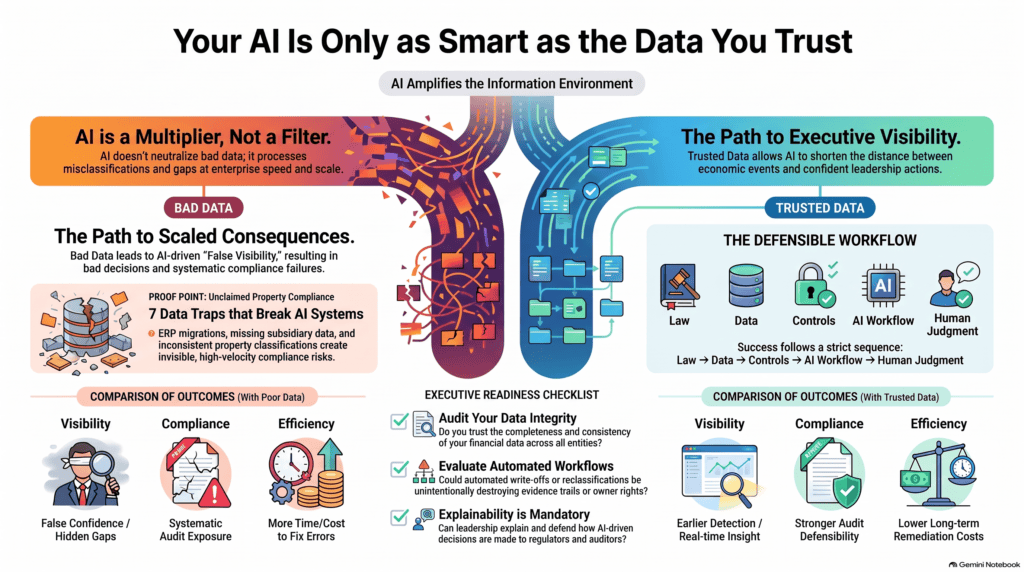
The infographic below lays out the sequence that makes AI defensible in a compliance setting:
Law → Data → Controls → AI Workflow → Human Judgment → Continuous Improvement
Notice where data sits. Second. Before controls. Before the AI workflow. Before human judgment gets involved.
That ordering is not accidental. It reflects a simple truth: every layer downstream is only as reliable as the data layer beneath it. Therefore, controls built on bad data enforce the wrong rules. AI workflows built on bad data produce confident wrong answers. Human judgment built on false visibility makes uninformed decisions.
The executive checklist in the infographic asks six questions that every CFO should be able to answer before deploying any AI-assisted compliance program:
- Do we trust the quality, completeness, and consistency of our financial data?
- Are all entities, systems, and historical data included in our AI-enabled processes?
- Could any automated workflow — write-offs, reclassifications — affect owner rights?
- Do we have visibility into potential unclaimed property developing today?
- Can we explain and defend how AI-driven decisions are made?
- Are we prepared for increasing regulatory and audit analytics?
Those are not technology questions. They are data governance questions wearing a compliance hat.
The Difference That Trusted Data Makes 💡
Here is what changes when the data is actually right.
Earlier detection of potential unclaimed property — because the system is monitoring the correct population. More accurate property classification — because the categories are defined consistently. Reliable dormancy tracking — because the dates and the rules match. Timely owner outreach — because the contact information is current. Stronger audit readiness — because the evidence trail is intact and reproducible.
Better data does not just produce better AI outputs. It changes what management can do with those outputs. Consequently, decisions that used to require weeks of reconstruction happen in hours. Obligations that used to surface during state exams get resolved before dormancy is reached. Assets owed to the company — unclaimed credits, vendor refunds, legacy balances — get identified and recovered instead of sitting forgotten in state databases.
That is a materially different compliance posture. And it starts before the AI does anything at all.
The Takeaway
AI will not save a compliance program built on data nobody trusts. It will accelerate the consequences of that data until a state examination or an audit makes them impossible to ignore.
The organizations that win with AI data quality in unclaimed property compliance will not be the ones with the most advanced tools. They will be the ones whose data gives those tools something worth working with. Better data. Smarter AI. Stronger finance. Greater compliance. That sequence only runs in one direction — and it starts with the data, every time.
👉 Your Next Step
Before executing your next financial cycle, ledger cleanup, or data migration, determine exactly where your compliance risk stands.
- Free 5-Minute Qualitative Risk Assessment: Get an instant risk score with zero generic advice at EscheatAnalyzer.ai.
- Free 60-Minute Executive Consultation: Schedule a deep-dive session with our specialists at moyerosibodu.com.
It is the recognition that AI-assisted compliance programs produce results only as reliable as the data they run on. When financial data is accurate, complete, and well-governed, AI can detect dormant property earlier, classify it more precisely, and route exceptions to professionals faster. When data has gaps — missing entities, broken ERP records, wrong classifications — AI processes those gaps at scale and produces outputs that look confident but cannot survive examination.
Manual processes fail slowly. A human reviewer working through a flawed data set catches some problems and misses others — the error rate stays roughly proportional to the work done. AI does not work that way. It applies the same rule to every transaction with equal speed and consistency. Therefore, a misclassified property type or a wrong dormancy date becomes embedded in every output the system produces, across every filing cycle, until someone specifically looks for the error.
Seven categories appear most often: misclassified property types, missing or inaccurate owner information, incomplete historical transaction records, entities excluded from the compliance scope, data lost during ERP conversions, automated write-offs without compliance review, and incorrect dormancy dates or state rule mappings. Any one of these can undermine a compliance program. Introduced into an AI-assisted workflow, each one scales with the system’s processing speed.
The defensible sequence is: Law → Data → Controls → AI Workflow → Human Judgment → Continuous Improvement. Data sits second in that chain — before controls, before AI workflows, before professional review. That ordering matters because every downstream layer is only as reliable as the data beneath it. Controls built on bad data enforce wrong rules. AI workflows built on bad data produce false visibility. Human judgment built on false visibility makes uninformed decisions.
First, do we trust the quality and consistency of our financial data? Second, are all entities, systems, and historical records included in our AI processes? Third, could any automated workflow affect owner rights? Fourth, do we have visibility into developing exposure today? Fifth, can we explain and defend how AI-driven decisions are made? Sixth, are we prepared for increasing regulatory audit analytics? These questions are not about the AI. They are about the data foundation the AI will run on.
The Escheat Risk Analyzer at EscheatAnalyzer.ai provides a free, 5-minute risk check across four areas — Jurisdictional, Compliance History, Transaction/Revenue, and Operational Complexity. The Operational Complexity area captures data governance factors — ERP conversions, entity completeness, system integration — most closely linked to AI data quality risk in unclaimed property programs. Results arrive instantly, with no cost required and no company name collected.
