
Your ERP Knows the Number. Your AI Doesn’t Know What Happened. 🧭
By Josiah S. Osibodu, CPA, CFE, Certified AI Consultant | 6-minute read
Part 3 of 4 — The Executive Financial Visibility™ Series
Part 1: The Action Distance | Part 2: The Trust Gap | Part 3: The Context Gap | Part 4: Coming Soon
The context gap in AI finance especially for unclaimed property compliance is the third hidden risk in this series — and honestly, it may be the most underestimated of the three.
Here is what I mean. Your ERP says a customer has a $47,500 credit balance. The number reconciles to the general ledger. It passes every automated validation rule in the system. Your AI can find it in milliseconds, compare it against millions of similar transactions, and flag it for review.
But why is it there?
Was it a duplicate payment? A pricing error? An unapplied remittance? Did it come over during an acquisition? Did the context explaining it survive the last ERP migration? Does the customer know the balance exists? And — eventually — could it become unclaimed property?
Those questions are not in your system. They never were. And if your AI is making decisions based on what the system recorded without understanding what economically happened, you have a Context Gap.
Understanding the Context Gap in AI Finance and Unclaimed Property 🔎
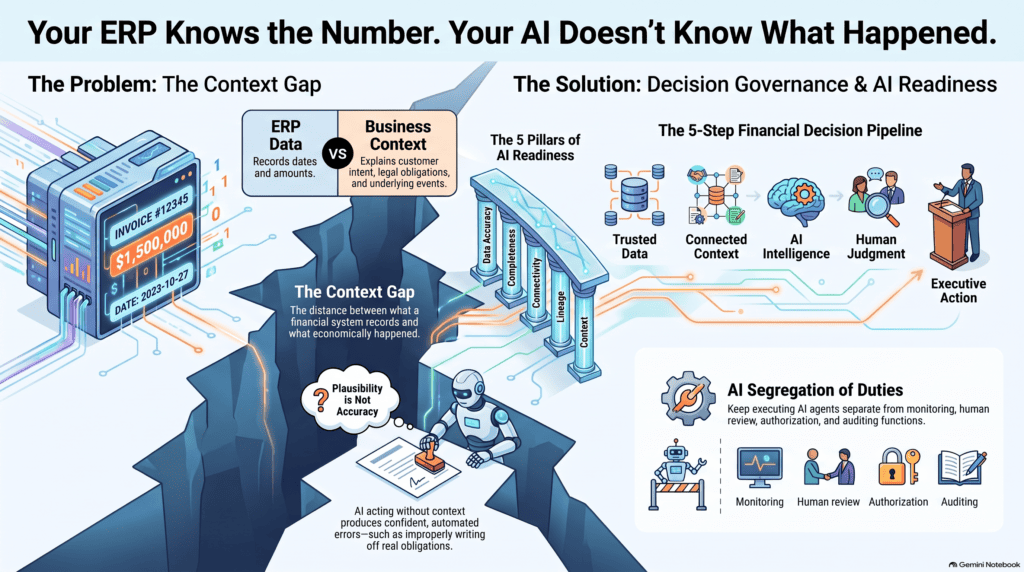
The simple version is this: financial systems record transactions. They do not always preserve the reasoning behind them.
The technical issue goes deeper. An ERP captures the what — the amount, the date, the account, the entity. Context explains the why — the business event that created the balance, the customer relationship behind it, the series of decisions that left it unresolved. Those two things travel separately. Often, context does not travel at all.
The business consequence follows directly. AI systems are extraordinarily good at finding patterns, summarizing data, and producing confident conclusions. But a confident conclusion built on an incomplete picture is not accuracy. It is plausibility dressed up as intelligence.
That distinction matters more than most finance leaders realize. AI can deliver an answer almost instantly and present it with complete confidence — whether that answer is right or wrong. The appropriate response is classic control discipline: define the inputs, define the expected outputs, and build review into the workflow before consequential action is taken. The Context Gap adds one more requirement on top of that: make sure the AI has enough information to understand what the data actually represents — not just what the system recorded.
Those are two very different things. And in regulated finance workflows, the gap between them is where the most defensible decisions either get made or quietly fall apart.
What Context Actually Means — and Where It Lives
Consider the $47,500 credit again. Your ERP can tell you the customer name, the balance, the age, the legal entity, and the account classification. All accurate. All reconciled.
What it probably cannot tell you is this:
- Whether this was a duplicate payment or a pricing adjustment
- Whether the customer has been contacted about it
- Whether it came over during an acquisition with no supporting detail
- Whether a prior employee made a decision about it that nobody documented
- Whether the original transaction relationship survived the last system migration
That information lives somewhere — in cash application notes, customer emails, remittance records, CRM activity, or the memory of a senior AR analyst who has been with the company for twelve years.
When that analyst leaves, the transaction stays. The reasoning goes with her.
The Context Gap Gets Wider Every Time Something Changes ⚠️
This is where I see the most practical risk for organizations deploying AI in finance right now.
The Context Gap does not stay constant. It widens during change events. Acquisitions. ERP implementations. Chart-of-account redesigns. Legal entity reorganizations. Shared service transitions. System migrations.
Each of those events creates an opportunity for data to survive while context disappears. A field gets mapped. A balance transfers. A customer ID changes. A subsidiary gets consolidated. A legacy system is retired. Technically, the migration succeeds. But the information explaining why a particular balance existed may never make the journey.
Five years later, the ERP still knows the number. Nobody knows the story.
AI does not automatically solve that problem. Depending on what it is asked to do, it can make the problem considerably harder to detect.
The Unclaimed Property Stress Test
Unclaimed property is useful here because it forces exactly the right question. Not “what does the system show?” but “what is the actual economic obligation represented by this balance?”
A credit is not automatically unclaimed property. An uncashed check is not automatically reportable. A write-off does not automatically extinguish an underlying legal duty. Determining what happened may require reconstructing a full chain of events:
Transaction → Payment → Application → Customer Activity → Accounting Treatment → Subsequent Events → Current Obligation
AI can help search, match, age, reconcile, compare, and surface exceptions across that chain. Genuinely helpful. But the professional reviewing those exceptions still needs to understand what they mean. A balance is data. Its history is context. Its legal disposition requires judgment. That principle does not change because the detection system got faster.
What Happens When AI Starts Acting — Not Just Analyzing 🤖
This is where the Context Gap becomes urgent rather than theoretical.
There is a meaningful difference between AI saying “I found 317 unusual customer credits” and AI saying “I reviewed and cleared 317 unusual customer credits.” The first produces information. The second changes the financial environment.
Once AI has authority to reclassify, reconcile, post, approve, or resolve transactions without preserving context in every step, Finance needs a principle that accountants will recognize immediately:
AI Segregation of Duties.
The system executing a consequential action should not be the only mechanism deciding whether its own action was appropriate. A stronger model looks like this:
AI Agent → Independent Monitoring → Exception → Human Review → Authorization → Action → Audit Trail
That is not a constraint on AI. It is exactly how Finance has learned to manage consequential human activity for decades. There is no reason to abandon it simply because the new actor happens to be software.
Closing the Context Gap Requires More Than Better Data 🛡️
The obvious response to all of this is “we need cleaner data.” That is true — but it is only part of the answer.
All fields are populated. Reconciliations close cleanly. Interfaces pass every test, and controls report green across the board. Yet management may still be unable to explain why a particular economic event occurred.
That is the uncomfortable truth about the Context Gap. An organization can have technically pristine data and still not understand what that data represents.
AI readiness needs five things, not one:
- Accuracy — is the recorded information correct?
- Completeness — do we have all relevant data?
- Connectivity — can we link related information across systems?
- Lineage — can we trace where information came from and how it changed?
- Context — can we explain the economic event behind the record?
The real architecture for AI-enabled finance is therefore not just:
Data → AI
It is:
Trusted Data → Connected Context → AI Intelligence → Human Judgment → Executive Action
Every transition matters. If context is missing at the second step, everything downstream can be wrong — confidently, consistently, and at scale.
The Takeaway
The Context Gap is not a data quality problem. It is a decision quality problem. And as AI moves from analysis into action — from surfacing exceptions to resolving them — the gap between what a system recorded and what actually happened becomes the most important unaddressed risk in AI-enabled finance.
Closing the context gap in AI finance especially for unclaimed property compliance is how you turn accurate numbers into trustworthy intelligence. Your ERP knows the number. The question is whether your organization — and the AI running on top of it — understands what happened. That distinction is the difference between automating a ledger entry and governing a financial obligation.
👉 Your Next Step
Before executing your next financial cycle, ledger cleanup, or data migration, determine exactly where your compliance risk stands.
- Free 5-Minute Qualitative Risk Assessment: Get an instant risk score with zero generic advice at EscheatAnalyzer.ai.
- Free 60-Minute Executive Consultation: Schedule a deep-dive session with our specialists at moyerosibodu.com.
❓ FREQUENTLY ASKED QUESTIONS
The Context Gap is the distance between what a financial system records and what actually happened in the business. An ERP captures amounts, dates, accounts, and entities accurately. What it does not always preserve is the economic reasoning behind a transaction — why a credit balance exists, whether an obligation was resolved, or what happened to historical relationships during an ERP migration. When AI makes decisions based on the recorded data without access to that context, it can reach plausible conclusions that are factually wrong.
Every major change event — acquisitions, ERP migrations, legal entity reorganizations, system retirements, employee turnover — creates an opportunity for data to survive while context disappears. A balance transfers. A customer ID changes. A legacy system is retired. Technically the migration succeeds. But the information explaining why a particular balance existed may not survive the transition. Five years later, the ERP still shows the number. Nobody can explain what created it or whether the underlying obligation still exists.
In unclaimed property compliance, the relevant question is never just what a system shows — it is what the economic obligation behind the balance actually is. A customer credit is not automatically reportable. A write-off does not automatically extinguish a legal duty. Determining what happened requires reconstructing the full chain of events from transaction to current obligation. AI can help search, match, and surface exceptions across that chain. However, the professional reviewing those exceptions still needs context to determine what they mean and what action the law requires.
AI Segregation of Duties applies a familiar accounting control principle to AI systems: the agent executing a consequential financial action should not be the only mechanism deciding whether its own action was appropriate. When AI has authority to reclassify, clear, or resolve transactions, an independent monitoring layer — separate from the executing agent — should review exceptions before authorization is granted. This is not a constraint on AI capability. It is exactly how Finance has managed consequential human activity for decades, applied to a new actor.
Closing the Context Gap requires accuracy — is the recorded data correct — completeness — do we have all relevant information — connectivity — can we link related data across systems — lineage — can we trace where data came from and how it changed — and context — can we explain the economic event behind the record. An organization can achieve the first four and still have a significant Context Gap if the fifth is missing. Only when all five are present does the architecture support trustworthy AI-driven decisions in regulated finance workflows.
The Escheat Risk Analyzer at EscheatAnalyzer.ai provides a free, 5-minute risk check across four areas — Jurisdictional, Compliance History, Transaction/Revenue, and Operational Complexity. The Operational Complexity area specifically captures context gap factors — ERP migrations, system transitions, acquisition history, and institutional knowledge risks — most closely linked to AI decision quality in unclaimed property programs. Results arrive instantly, with no cost required and no company name collected.
