
Your AI Is Working. But Is It Creating Value? 💡
By Josiah S. Osibodu, CPA, CFE, Certified AI Consultant | 6-minute read
Part 4 of 4 — The Executive Financial Visibility™ Series
Part 1: The Action Distance | Part 2: The Trust Gap | Part 3: The Context Gap | Part 4: The Value Gap™
The AI value gap in finance and unclaimed property compliance is the final and most important risk in this series — because it is the one executives are least equipped to measure right now.
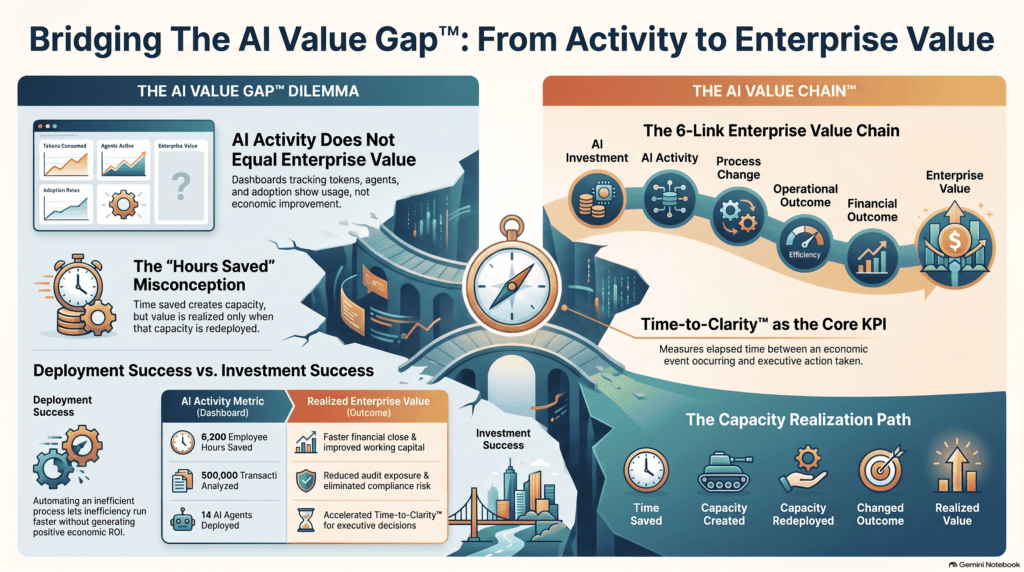
Imagine a CFO dashboard that reads: 14 AI agents deployed. 8.7 million tokens consumed. 42,000 transactions analyzed. 6,200 employee hours saved. 94% adoption across the Finance team. Every indicator is green.
Now ask the harder question: how much enterprise value did the company actually create?
That question changes the entire conversation. An organization can know exactly how much AI it is using without having any clear picture of how much value that AI is producing. A successful deployment and a successful investment are not the same thing — and most Finance organizations are currently measuring the first while assuming it proves the second.
Understanding the AI Value Gap in Finance and Unclaimed Property 💡
The simple version: AI activity is not AI value.
The technical distinction matters. There is a chain between an AI investment and enterprise value — and it has more links than most dashboards show:
AI Investment → AI Activity → Process Change → Operational Outcome → Financial Outcome → Enterprise Value
Most AI measurement concentrates near the top of that chain. Licenses purchased, active users, agents deployed, hours saved. These are real numbers. They are not useless. But they answer — “how much AI are we using?” — not “what became economically better because we used it?”
The Value Gap™ is the distance between those two questions. It lives most commonly between the capacity AI creates and the value that capacity eventually produces — or fails to.
The Most Misleading Metric in AI Right Now
Here is the one worth examining closely: hours saved.
Organizations frequently convert AI time savings into financial value this way — 2,000 hours saved, multiplied by a fully loaded hourly rate, equals a declared benefit. Clean math. Often wrong economics.
The question that the math skips is: what happened to those 2,000 hours?
If employees absorbed the capacity without any change in output, cost, revenue, risk, or decision quality, the organization created capacity. It did not necessarily create $150,000 of realized value. Those are meaningfully different things — and treating them as equivalent is how organizations end up scaling AI spending while struggling to articulate what changed.
The actual progression worth measuring is:
Time Saved → Capacity Created → Capacity Redeployed → Changed Outcome → Realized Value
The gap between the first step and the last is where the value conversation needs to happen.
The AI Value Chain™ — A Framework CFOs Can Actually Use 🔎
This is where the conversation moves from critique to structure.
Suppose AI reduces reconciliation work by 3,000 hours. Stopping at “3,000 hours saved” is incomplete. Follow the chain properly:
3,000 hours saved → Finance closes two days earlier → exceptions reach management sooner → analysts investigate material variances instead of assembling data → forecast quality improves → management acts on earlier, better information → working capital decisions improve.
Now the organization is measuring value. The first number tells management the technology worked. The last outcome tells them whether the investment was worth it.
CFOs need this chain visible — not just the first link.
Don’t Automate a Process You Should Redesign ⚠️
This may be the most important thing in this entire series.
There is a tendency to deploy AI on top of existing processes without asking whether the process itself should exist in its current form. Two paths diverge here:
Path A: Existing process → Add AI → Faster existing process
Path B: Understand the objective → Challenge the process → Redesign the workflow → Apply AI → Measure the outcome
The difference is significant. If a reconciliation requires 1,000 hours today, the objective should not automatically be to have AI perform the same 1,000-hour process at machine speed. The better question is: why does the process require 1,000 hours at all?
Automating an inefficient process does not transform it. It allows inefficiency to operate faster — which, depending on what the process is actually doing, can make things worse rather than better.
The AI P&L — What CFOs Should Start Building Now 📊
Organizations create AI business cases before implementation. Then the project gets approved, work begins, and six months later almost nobody revisits the original economics.
The alternative is to treat material AI capabilities the way Finance treats a business operation — with an ongoing view of what they cost, what they produce, and whether the economics justify continued investment:
- Investment: infrastructure, model, and software costs
- Operating cost: compute, tokens, monitoring, human review
- Output: work performed and exceptions surfaced
- Quality: error rates, override rates, false positives
- Risk: control exceptions, incidents, audit exposure
- Economic benefit: cost reduction, avoided loss, earlier decisions, improved capital allocation
- Net value: actual enterprise contribution
Call it the AI P&L. Not a GAAP statement — an executive management tool. The test is simple: if this AI capability were a business unit, could the CFO explain clearly how it creates value? If not, the organization probably does not understand the economics yet.
Connecting the Value Gap to Unclaimed Property
This series began with unclaimed property as the proof point — and it applies here too.
An AI system analyzes 500,000 historical unclaimed property transactions and flags 12,000 potential exceptions. Management celebrates: half a million transactions reviewed. That is an activity metric.
The value questions tell a different story. Legitimate exceptions matter more than total exceptions flagged. Exposure identified before dormancy sets in has more value than exposure discovered during a state exam. False positives eliminated before a professional wastes time on them reduce cost in a way that transaction volume never captures. Earlier management awareness of risk creates options that late discovery removes entirely. Consequently, a more defensible compliance posture — one that holds up under examination — is the outcome that actually justifies the investment.
Five hundred thousand transactions analyzed is a number. A materially better compliance decision — made earlier, with better evidence, at lower cost — is an outcome. Those are not the same thing. Closing the AI value gap in unclaimed property means measuring the second, not just counting the first.
Time-to-Clarity™ — The Finance KPI AI Actually Changes 🎯
Traditional Finance measures days to close, forecast accuracy, DSO, cost per transaction. These are all useful.
AI introduces something more meaningful: Time-to-Clarity™ — the elapsed time between an economically significant event occurring and management having enough reliable information to understand it and act.
Fast data is not the same as fast understanding. The highest value AI can produce in Finance may ultimately be reducing the distance between:
Economic Event → Management Understanding → Executive Action
That connects the entire series. The Action Distance asked whether AI sees things quickly enough. The Trust Gap asked whether the data is reliable enough to act on. The Context Gap asked whether AI understands what happened. The Value Gap asks whether any of it produced a business outcome worth the investment.
Together, they form a single framework:
Trust → Context → Action → Value
And the CFO is accountable for all four.
The Takeaway
The first generation of enterprise AI asked whether the technology worked. The next will ask whether the economics worked. Those are different questions — and Finance organizations that cannot answer the second one are running an AI program they do not fully understand.
Closing the AI value gap in finance and unclaimed property means holding AI to the same standard that Finance holds every other investment: not whether it is running, but whether it is producing outcomes worth what it costs. Don’t show the CFO how much AI the organization is using. Show them what became economically better because of it. That is the only metric that ultimately matters.
👉 Your Next Step
Before executing your next financial cycle, ledger cleanup, or data migration, determine exactly where your unclaimed property compliance risk stands.
- Free 5-Minute Qualitative Risk Assessment: Get an instant risk score with zero generic advice at EscheatAnalyzer.ai.
- Free 60-Minute Executive Consultation: Schedule a deep-dive session with our specialists at moyerosibodu.com.
❓ FREQUENTLY ASKED QUESTIONS
The Value Gap™ is the distance between measurable AI activity and measurable enterprise benefit. An organization can deploy AI successfully — high adoption, millions of transactions processed, thousands of hours saved — without those metrics proving that anything economically significant improved. The gap lives most commonly between the capacity AI creates and the value that capacity eventually produces. Closing it requires measuring outcomes, not just activity.
Hours saved measures capacity created — not value realized. When AI reduces Finance work by 2,000 hours, the critical question is what happened to those hours. If employees absorbed the time without any change in output, decision quality, cost, or risk, the organization created capacity and declared it value. The actual progression that produces economic benefit is: Time Saved → Capacity Redeployed → Changed Outcome → Realized Value. Most AI dashboards stop at the first step and treat it as the last.
The AI Value Chain™ traces the full progression from AI investment to enterprise value: AI Investment → AI Activity → Process Change → Operational Outcome → Financial Outcome → Enterprise Value. CFOs should use it to identify where value is being created and where the chain is broken. If AI reduces reconciliation time but Finance close speed does not improve and management decisions do not change, the chain is broken somewhere between operational and financial outcome — and the investment has not yet proved its economics.
The AI P&L is an executive management construct — not a GAAP statement — that tracks investment, operating cost, output, quality, risk, and economic benefit for a material AI capability over time. It treats the AI capability the way Finance treats a business operation: with ongoing visibility into whether the economics justify continued investment. The test question is simple: if this AI capability were a business unit, could the CFO explain clearly how it creates value? If the answer is uncertain, the organization likely does not understand the economics yet.
Time-to-Clarity™ measures the elapsed time between an economically significant event occurring and management having enough reliable information to understand it and act. It is more meaningful than processing speed because fast data is not the same as fast understanding. AI’s highest value in Finance may ultimately be reducing the distance between economic event, management understanding, and executive action — not simply doing existing work faster. That shift from speed metrics to clarity metrics reflects what AI actually changes about decision quality.
The Escheat Risk Analyzer at EscheatAnalyzer.ai provides a free, 5-minute risk check across four areas — Jurisdictional, Compliance History, Transaction/Revenue, and Operational Complexity. It surfaces the compliance gaps most likely to represent the Value Gap in unclaimed property programs — exposure that AI activity has not yet converted into resolved obligation or reduced audit risk. Results arrive instantly, with no cost required and no company name collected.
