
AI Just Made Your Consultant Faster. Should Your Bill Go Down? 💡
By Josiah S. Osibodu, CPA, CFE, Certified AI Consultant | 7-minute read
The Final Chapter — Executive Financial Visibility™ Series
Part 1: The Action Distance | Part 2: The Trust Gap | Part 3: The Context Gap | Part 4: The Value Gap™ — Pricing Edition
The AI consulting fees value gap in unclaimed property is the conversation the industry has not had yet — and I am probably not the most popular person in the room for starting it.
I don’t particularly want to start a fight with consulting firms. I am one. But I am going to ask the question anyway.
If AI lets your consultant complete in hours what once took weeks — should your consulting bill go down?
AI Consulting Fees, the Value Gap, and Why This Conversation Has to Happen 💡
Let me be honest about where I am coming from before I say anything else.
For the better part of the past decade, I assisted a global multi-billion-dollar technology company with a substantial unclaimed property compliance initiative. Multi-state audit initiated by Delaware. Multi-state voluntary disclosures. Annual compliance reporting. Policy design and rollout. Corporate asset recovery. It was complicated work, and there was a lot of it.
Before I became a solo practitioner — and before AI changed the way I now work — that engagement could easily have required a team of eight or more people. Managers. Senior consultants. Consultants. Analysts. Researchers. People gathering data, analyzing data, preparing workpapers, and reviewing workpapers that other people prepared.
That is the traditional consulting leverage model. It made sense for decades. AI is challenging it in ways the profession has not fully grappled with yet.
My Virtual Team Has No HR Drama
I want to be clear about something. I did not use AI during that decade-long engagement. However, I had a front-row seat as the technology evolved — which is partly why it fascinated me enough to earn my AI certification in December 2025.
Since then, the way I work has changed. I have what I jokingly call my virtual team (my primary tech stack):
- Claudette — Claude.ai
- Charlie — OpenAI ChatGPT
- Gemmy — Google Gemini + NotebookLM
- Peppe — Perplexity.ai
They are available 24/7. They do not complain about weekends. And so far, there has been remarkably zero HR drama.
The serious point underneath that: tasks that once took weeks can now be compressed into hours. That changes the economics of professional services in a way nobody has fully priced yet — including me.
The Traditional Model Has a New Problem ⚠️
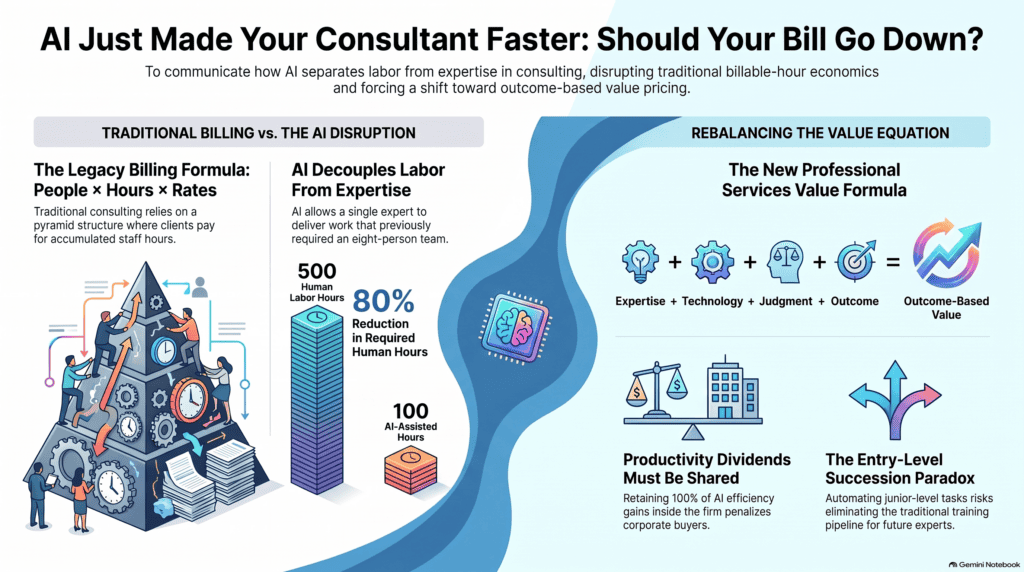
Here is the consulting equation that has governed professional services for generations:
People × Hours × Billing Rates = Fees
A pyramid develops. Partners at the top. Managers overseeing the work. Junior professionals performing the labor-intensive analysis underneath. The client pays for all of that accumulated time.
That model made sense when expertise and labor were difficult to separate. AI is beginning to separate them.
Consider what a complex unclaimed property engagement once required:
- Junior consultant: 40 hours of population testing
- Senior consultant: 12 hours of analysis
- Manager: 6 hours of review
- Partner: 2 hours of oversight
Today, AI may handle a meaningful portion of the research, extraction, reconciliation, and initial analysis. The experienced professional still reviews the facts, challenges the conclusions, applies judgment, and assumes full responsibility. But perhaps the engagement now requires AI running for hours and a professional applying judgment — not four levels of a staffing pyramid billing time.
What exactly should the client pay for? The hours? Or the outcome?
The Uncomfortable Middle Ground
Here is where it gets genuinely hard to argue on either side.
A consultant with over 25 years of unclaimed property experience can solve in three hours a problem that might take a less experienced professional 30 hours. Should the expert earn one-tenth the fee because they finished faster? I don’t think so. That creates the wrong incentive entirely — it punishes expertise.
But consider the other side. If a traditional team would historically spend 500 hours on data extraction, population testing, and workpaper preparation — and AI reduces the necessary human effort to 100 hours — should the client receive an invoice economically equivalent to 500 hours simply because that is what the engagement used to cost?
That is much harder to defend.
Hourly pricing can punish efficiency. But AI efficiency retained entirely by the consulting firm can punish the client. The answer probably sits somewhere between those two extremes.
Maybe We Have Been Pricing the Wrong Thing 🔎
Here is a reframe worth sitting with.
Suppose two consultants both identify $2 million of unnecessary financial exposure in a client’s unclaimed property program. Consultant A takes 100 hours. Consultant B uses two decades of experience and AI to find the same answer in 10 hours.
Is Consultant B worth 90% less?
Of course not. The client may actually prefer Consultant B precisely because the answer arrived faster — when management still had time to act.
So the emerging economic equation may look less like:
Hours Billed = Fees
And more like:
Expertise + Technology + Judgment + Outcome = Value
That is a fundamentally different professional services model. Value pricing has been debated for decades. AI has changed the economics behind that debate in ways that make it harder to avoid.
But Value Pricing Cannot Become an Excuse Either ⚠️
There is another side to this argument, and I want to name it directly.
Consulting firms could respond: “Fine. We won’t bill by the hour. We’ll charge based on value.”
Fair enough. But value pricing should not become a convenient mechanism for retaining 100% of AI productivity gains while calling the same fee something different. Sophisticated clients will eventually notice.
If AI allows a firm to complete engagements faster, analyze larger populations, and automate portions of historically labor-intensive work — and none of that shows up in the client’s economics — the Value Gap has not closed. It has simply moved inside the firm.
The better future probably looks like this:
- The consulting firm earns stronger margins because their delivery costs fall
- The client pays less than historical cost, or receives materially more for the same fee
- The experienced professional spends less time on low-value tasks
- Everyone benefits from faster insight and better decisions
That is what closing the AI consulting fees value gap should actually look like.
The Question Nobody in My Profession Wants to Answer 🎯
There is one more uncomfortable question I will raise before closing.
What happens to junior consultants if AI performs the work they once used to learn the profession?
The traditional leverage model was not just an economic pyramid. It was a training pyramid. Junior professionals tested transactions. They made mistakes. Managers corrected them. Over time they developed judgment. Eventually some became partners.
If AI removes much of that foundational work, firms face a real paradox: how do you produce tomorrow’s experts when AI performs the work that once trained today’s experts? Hiring fewer junior professionals may improve this year’s margins while eliminating the succession pipeline that keeps the firm viable in ten years.
That may ultimately be a bigger strategic problem than pricing.
The Value Gap Comes Full Circle
This series has examined four gaps in executive financial visibility:
- The Action Distance — how long between an economic event and meaningful action?
- The Trust Gap — can management trust the data AI is using?
- The Context Gap™ — does the organization understand what happened behind the number?
- The Value Gap™ — did AI actually produce a measurable benefit?
And now the final question, which may be the most uncomfortable:
Who gets that value?
If AI creates enormous efficiency gains and those gains stay entirely inside the consulting firm — the Value Gap has not disappeared. It has just moved from the client’s problem to the industry’s unresolved question.
The Takeaway
For decades, consulting economics largely rewarded time. AI increasingly rewards judgment multiplied by technology.
The AI consulting fees value gap in unclaimed property — and in professional services broadly — will close whether firms choose to lead that conversation or not. The firms that engage it honestly will build stronger client relationships, better economics, and more defensible value propositions. The ones that avoid it will eventually face clients who have started asking the question without them.
So I will end where I started: if AI lets your consultant do in hours what once took weeks — should your bill go down?
My answer? Sometimes, yes. But the more important question is who should benefit from the value AI created.
Because the next disruption in professional services may not be AI replacing consultants. It may be AI forcing consultants — and their clients — to finally agree on what expertise is actually worth.
👉 Your Next Step
Before your next consulting engagement — or your next unclaimed property examination — find out where your actual unclaimed property risk exposure stands.
- Free 5-Minute Qualitative Risk Assessment: Get an instant risk score with zero generic advice at EscheatAnalyzer.ai.
- Free 60-Minute Consultation: Schedule a conversation with Josiah directly at moyerosibodu.com.
❓ FREQUENTLY ASKED QUESTIONS
The AI consulting fees value gap is the disconnect between the efficiency gains AI creates inside a consulting firm and what actually reaches the client in the form of lower fees, faster delivery, or better outcomes. When AI compresses 500 hours of work into 100 hours but the invoice stays roughly equivalent, the productivity dividend stayed inside the firm. For unclaimed property clients — already paying significant state assessments — that gap is increasingly hard to justify.
Sometimes, yes. When AI eliminates large amounts of low-value manual work — data extraction, population testing, workpaper preparation, regulatory research — and nothing else changes about the engagement, clients have a reasonable basis to expect some economic benefit. However, the answer is not simply that AI makes consulting cheap. The better outcome is that AI makes consulting economics better for both sides: the firm earns stronger margins because delivery costs fall, and the client receives more value or lower cost than the historical model provided.
Significantly. The traditional model worked because expertise and labor were difficult to separate — you needed many hours of junior professional time to deliver an engagement. AI separates them. An experienced professional with AI tools can now compress weeks of junior-level work into hours, while still applying the judgment, responsibility, and accountability that clients actually depend on. The pyramid structure that once drove both economics and training is under real pressure from that shift.
This is the harder strategic question underneath the pricing debate. The traditional leverage pyramid was not just economic — it was a training pipeline. Junior professionals learned the profession by doing the foundational work. If AI performs that work, firms face a succession paradox: how do you develop tomorrow’s experienced professionals when AI has taken over the work that produced them? Cutting junior headcount may improve near-term margins while eliminating the pipeline that keeps a firm viable over time.
For many engagements, yes — but with an important caveat. Value pricing should not become a mechanism for firms to retain 100% of AI productivity gains while calling the same fee something different. The principle that matters more than any specific pricing model is this: the productivity dividend from AI should not belong exclusively to one side of the relationship. If that principle guides the pricing conversation, the specific mechanism — fixed fee, value pricing, outcome components, subscription — becomes a secondary question.
The Escheat Risk Analyzer at EscheatAnalyzer.ai provides a free, 5-minute risk check across four areas — Jurisdictional, Compliance History, Transaction/Revenue, and Operational Complexity. It gives your finance and legal team a structured, independent picture of where your largest exposure drivers are before any consulting conversation begins. Results arrive instantly, with no cost required and no company name collected.
