
You’re Not Paying for Hours Anymore. So What Are You Actually Paying For?
By Josiah S. Osibodu, CPA, CFE, Certified AI Consultant | 5-minute read
Something shifted in professional services, and most finance teams felt it without quite naming it.
The invoices changed. Fixed fees replaced hourly billing. Faster delivery became the norm. Outcome-based work started showing up in engagement letters. That part was visible.
What wasn’t visible — and still isn’t, for most companies — is what the new model actually means for unclaimed property advisory value. Because the fee structure changed, but the underlying risk didn’t. And if you’re buying the new packaging without understanding the new product, you’re leaving something expensive on the table.
Here’s the plain version: you’re not buying hours in a conference room anymore. You’re buying the gap between what your internal team can see and what an experienced outside advisor finds before a regulator does.
That gap is the product. And in unclaimed property, it’s almost always larger than your team expects.
What Unclaimed Property Advisory Value Actually Means
Your finance team is good at their jobs. That’s not the question. The question is whether their visibility covers the full picture — or just the current one.
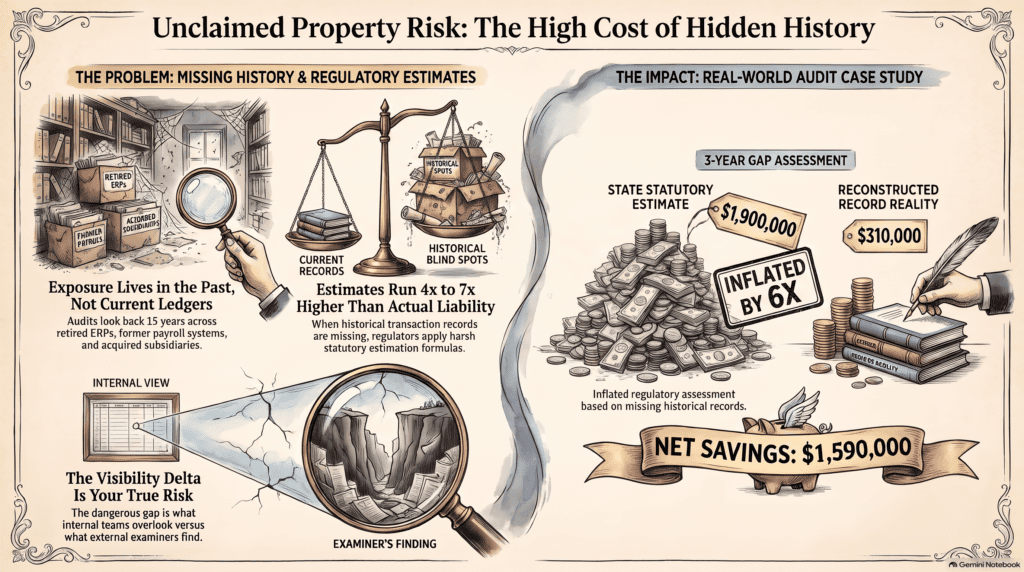
Unclaimed property exposure doesn’t live in your general ledger today. It lives in what happened before today: the entities you acquired, the systems you retired, the payroll platforms you replaced. Records from those periods may not exist in your current system. However, they exist in the examiner’s playbook.
Delaware runs audits covering roughly 15 years of transactions. That lookback crosses system migrations for most large companies. It spans acquisitions made under previous leadership. It reaches back to vendor checks issued under a controller who left in 2019.
The Three-Layer Problem Most Finance Teams Miss
Here’s the simple version: your compliance software reports what it was fed. It doesn’t tell you what’s missing.
The technical layer is sharper. Every ERP migration creates a closed-item gap. Open transactions move. Closed ones — old checks, customer credits, stale AP — often don’t. Every acquisition brings a legacy record set that may or may not have migrated cleanly into the parent system. Dormancy periods run 1 to 5 years depending on property type and state. A 15-year lookback crosses multiple such transitions for most Fortune 1000 companies.
The business impact is direct. When records are missing, examiners estimate. Delaware’s estimation method applies error rates and industry averages to your known filing history and projects backward. In practice, estimated liability runs 4 to 7x higher than documented liability for the same period. That multiplier is the real risk — not the face value of any individual check.
What Happened When a Client Couldn’t Reconstruct Three Years
Here’s a concrete case. A company acquired a regional firm in 2016. The parent ERP absorbed open items only. Closed AP transactions, uncashed checks, and customer credits stayed in the legacy system — which retired in 2018.
A 2026 Delaware audit covered transactions beginning January 1, 2011. The examiner asked for uncashed check data for 2016 to 2018. Nothing existed in any current system.
Delaware estimated $1.9M for those three years. The documented balance — had records survived — was $310,000.
The advisor who saw that gap before enrollment and rebuilt the records from archived data saved the client $1.59M. Consequently, that result had nothing to do with hours billed. It had everything to do with knowing exactly where to look and what to do with what they found.
Why the Billing Shift Exposed a Harder Question
When the profession moved toward value-based pricing, it changed the conversation. Clients started asking: if you deliver the same insight in half the time, shouldn’t the fee drop?
Sometimes, yes. But in unclaimed property, that question misses the point entirely.
The value was never the time. It was the judgment — which records matter, which gaps carry real risk, which periods need reconstruction before an examiner asks. Therefore, a faster delivery doesn’t reduce that value. If anything, faster delivery of the right answer is worth more, not less.
The companies that understand this aren’t shopping for the lowest hourly rate. They’re buying certainty. Specifically, they’re buying the ability to walk into an exam with documentation instead of estimates.
Get Ahead Before the Window Closes
The Delaware Voluntary Disclosure Agreement (VDA) program has a 90-day window. Enrollment waives penalties and interest. Non-enrollment leads to referral for exam — with that 15-year lookback and no protection from estimation.
The gap between what your internal team can see and what an examiner will find is closable. However, it requires asking the right questions before enrollment, not after.
That starts with 15 qualitative questions about your company’s history — not a general ledger pull. Which systems did you retire? What entities did you acquire along the way? And which records didn’t survive a migration? Those answers tell you where the risk sits.
Then you decide what to do about it.
👉 Your Next Step
Before executing your next financial cycle, ledger cleanup, or data migration, determine exactly where your compliance risk stands.
- Free 5-Minute Qualitative Risk Assessment: Get an instant risk score with zero generic advice at EscheatAnalyzer.ai.
- Free 30-Minute Executive Consultation: Schedule a deep-dive session with our specialists at moyerosibodu.com.
❓ FREQUENTLY ASKED QUESTIONS
It means the practical gap between what your internal team can find in current records and what an examiner will look for across the full 15-year lookback. In most large companies, that gap sits in acquired entities, retired systems, and records that didn’t survive migrations. Closing it before an audit starts is the core service. That’s what you’re paying for — not hours worked.
Delaware applies error rates and industry averages to your known filing history, then projects that rate backward across the missing years. In practice, those estimated figures run 4 to 7x higher than what documented records produce for the same period. So, a three-year gap with a true balance of $300,000 can become a $1.2 to $2.1M assessment. Missing records are a financial risk, not just an operational gap.
Companies with two or more acquisitions in the last 15 years, any ERP migration since 2010, or divested entities whose records stayed with the legacy system. Specifically, accounts receivable credits, uncashed checks, and unidentified remittances from those transition periods are the highest-risk property types. These balances age out of active AR and AP reviews — but they don’t age out of Delaware’s lookback.
Yes — and the shift matters. Under hourly billing, you paid for time spent. Under value-based pricing, you’re paying for findings: which gaps carry real risk, which periods need records rebuilt, and which conclusions can hold up under scrutiny. Therefore, the right question isn’t “how many hours will this take?” It’s “what can you find that my team can’t see, and what does it cost if we miss it?”
Run a qualitative review of your company’s history first — not a general ledger pull. The most useful step is asking 15 structured questions about which systems you retired, which entities you acquired, and which records didn’t survive migrations. That review tells you where the gaps likely sit. Once you know that, you can decide whether to pursue the VDA, engage outside help, or build a records reconstruction plan before filing.
Yes. EscheatAnalyzer.ai runs a free 5-minute qualitative assessment covering the 15 historical questions most compliance platforms never ask. Results arrive instantly, with no cost required and no company name collected. The output shows which areas of your company’s history carry the highest undetected risk — giving your team a baseline before anyone pulls a ledger or engages outside counsel.
