
The Parking Lot Problem: What AR Unclaimed Property Fraud Risk Tells You About Your General Ledger
By Josiah S. Osibodu, CPA, CFE, Certified AI Consultant │ 5-minute read
Your AR team closed the books. The numbers balanced. Nobody flagged anything. That doesn’t mean nothing happened. It means the entry landed somewhere nobody checked. I’ve spent years finding it.
The parking lot.
What Lives in the Parking Lot
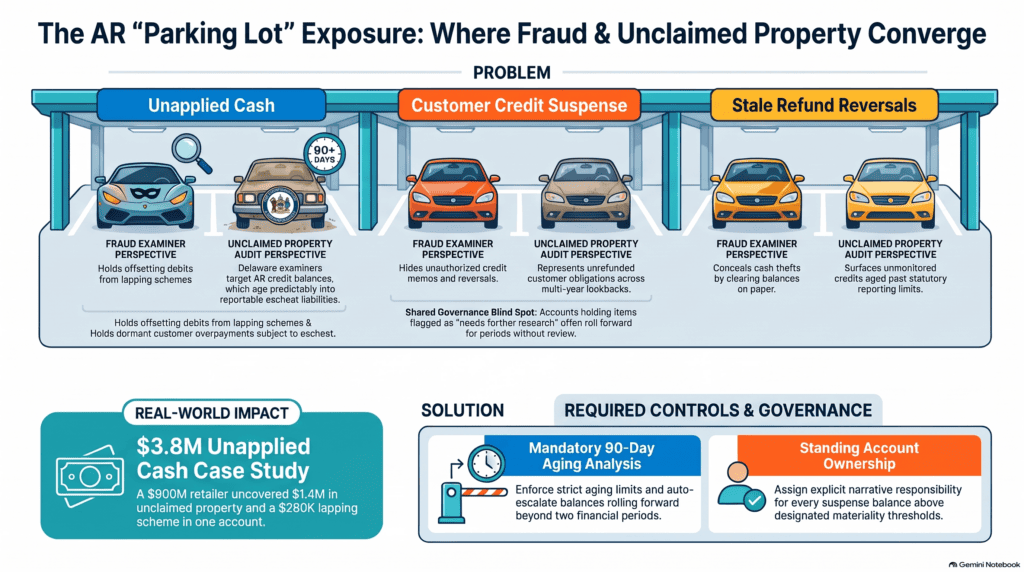
Unapplied cash. Outstanding credit memos. Customer credit suspense. Stale refund reversals. Overpayments swept somewhere at period-end. Unreconciled items carried forward because nobody wanted to explain them this quarter.
Every large company has them. They serve a real purpose — absorbing transactions that don’t fit neatly anywhere else, that need more research, that arrived without a clear home. The accounts aren’t the problem. What happens to them over time is.
In a fraud scheme, these accounts absorb the concealment entry. The credit that offsets a fictitious customer refund. The reversal that restores a number without restoring the cash behind it. The unapplied payment someone redirected before it found its invoice.
In a Delaware unclaimed property examination, the examiner goes straight to these accounts. Customer overpayments, unapplied deposits, and credit balances that companies never refunded or applied carry some of the highest-concentration exposure in a typical review — and they accumulate in exactly these accounts. Delaware removed unvouchered AP from its definition of unclaimed property. AR didn’t get the same reprieve. Customer credits remain firmly in scope, and they age predictably.
Both disciplines understand something most internal review processes miss: parking spots are where decisions someone didn’t want to document eventually surface.
What I’ve Seen Working Both Sides
I am both a CPA and a CFE. That combination is unusual in unclaimed property work — most practitioners come from one side or the other. After working both disciplines for years, I’ve arrived at a specific, uncomfortable insight.
Notably, the accounts that show up most often in fraud examinations and unclaimed property audits are not the ones with the largest balances. Instead, they’re the ones with the most unexplained activity and the least governance.
That asymmetry isn’t an accident. In fact, it’s a feature of how pressure works inside a finance function.
When a quarter is closing and a customer payment doesn’t match an open invoice, the path of least resistance is to park it and flag it for follow-up. As a result, the follow-up almost never happens. The item rolls forward. It ages. By the time anyone looks at it again — if anyone looks — the transaction is old enough that the person who created it may no longer be with the company.
That’s not a fraud story on its own. That’s just a process story. But it’s the same starting point.
A Retail Company, an AR Clerk, and 14 Months Nobody Noticed
Consider a retail company with roughly $900 million in annual revenue. Their unapplied cash account carried $3.8 million — customer payments received without a matching invoice, swept into a holding account for “further research,” rolled forward for two and a half years.
A Delaware examination flagged the account. The review found two things: $1.4 million in dormant customer credits that should have been reported as unclaimed property, and $280,000 in reversals that didn’t correspond to any recoverable customer balance.
The fraud examination, filed five months later, identified the $280,000 as a lapping scheme run by an AR clerk over 14 months.
Both findings came from the same account. Neither team had reviewed it before the examiner walked in.
The Governance Question Nobody Is Asking
Here’s what I’d ask any CFO or controller right now: What is sitting in your unapplied cash and customer credit accounts? How old is it? Who last touched it — and why?
Those are not financial audit questions. They’re governance questions. The distinction matters because financial audit questions get answered once a year, in a defined scope, by a team with a fixed mandate. Governance questions need standing answers — someone who owns the account, reviews it on a defined cycle, and can explain every aged item above a materiality threshold.
Most companies don’t have that. The account exists. The balance rolls. No one is responsible for the narrative behind it.
That gap is where both disciplines — fraud examination and unclaimed property compliance — find their most productive work.
What Changes When You Look at the Parking Lot First
Companies with strong unclaimed property compliance programs and resilient internal controls share one characteristic: they treat unexplained AR balances as a governance signal, not an operational inconvenience.
These companies review unapplied cash and customer credit accounts on a defined cycle. Aging analysis is required on anything over 90 days. Items that roll forward more than two periods without resolution get escalated. And “needs further research” is treated as a temporary state — not a permanent home.
That discipline doesn’t just reduce unclaimed property exposure. It shrinks the surface area where fraud can live undetected.
The parking lot is not a neutral place. It’s one of the most informative areas of your general ledger — and one of the least reviewed. That gap doesn’t stay empty. Something always fills it.
The question is whether you find it first, or wait for someone else to tell you what they found.
👉 Your Next Step
Before executing your next financial cycle, ledger cleanup, or data migration, determine exactly where your compliance risk stands.
🔍 Free 5-Minute Qualitative Risk Assessment:
Get an instant risk score with zero generic advice at EscheatAnalyzer.ai.
📞 Free 30-Minute Executive Consultation:
Schedule a deep-dive session with our specialists at moyerosibodu.com.
❓ Frequently Asked Questions
Customer overpayments, unapplied deposits, and credit balances (including outstanding credit memos) that were never refunded or applied are firmly within Delaware’s definition of unclaimed property — and they tend to age in AR accounts without triggering the same review attention as an open invoice. Delaware removed unvouchered AP from its unclaimed property definition, but AR didn’t get the same treatment. Customer credits remain fully in scope. In a typical examination, the examiner requests transaction-level AR data across the full lookback period — about 15 years — and flags every credit balance that wasn’t reported, refunded, or demonstrably applied to a customer transaction. For companies with high transaction volume, the concentration of unreported customer credits in unapplied cash and suspense accounts can be substantial.
Every fraudulent transaction requires a balancing entry. In AR fraud schemes — lapping, fictitious credits, unauthorized reversals — the concealment entry has to land somewhere with low review frequency. Unapplied cash accounts, customer credit suspense lines, misc. income, and stale refund reversals are the natural destination. The double-entry requirement that makes accounting reliable also makes fraud leave a trail. The fraud examiner’s job is to follow the second footprint — and in AR schemes, that footprint ends up in the same accounts a Delaware examiner would flag for dormant customer credits. Both disciplines are reading the same general ledger. The question is who gets there first.
Lapping is an AR fraud scheme where a clerk steals a customer’s payment, then covers the theft by applying a later customer’s payment to the first account — cycling the shortage forward through multiple accounts to avoid detection. The concealment entries typically pass through unapplied cash or customer credit suspense accounts, where they can age without triggering an immediate reconciling flag. Those same accounts often contain legitimate dormant customer credits from overpayments or unapplied deposits — which are unclaimed property. A single unapplied cash account can hold both a fraud concealment entry and a reportable owner obligation at the same time. Neither surfaces without a governance-driven review of the aging detail.
During a Delaware examination, the examiner typically requests aged AR transaction history across the lookback period — customer payments, credit memos, refund records, unapplied cash details, and write-off/write-on of credits. Every credit balance that can’t be explained as resolved — through application to an invoice, a confirmed refund, a bad-debt recovery, or a valid error — is treated as a potential reportable customer obligation. For gap years where records are incomplete or in unacceptable formats, Delaware applies projection methods based on available sample periods. That means unreviewed AR balances from past years can generate estimated liability even if the original items no longer exist in a readable format.
Effective governance on unapplied cash and customer credit accounts typically includes four elements: a named account owner with a formal review mandate, mandatory aging analysis on any item over 90 days, an escalation path for items that roll forward more than two periods without resolution, and a periodic sweep to identify credit balances that meet state reporting thresholds. Companies that treat “needs further research” as a permanent classification — rather than a temporary state with a resolution deadline — tend to show up in examinations with the largest aged balances and the most difficulty explaining them. The same review cycle that surfaces reportable unclaimed property also surfaces the anomalies that warrant a fraud examination look.
EscheatAnalyzer.ai is a free, qualitative risk assessment that evaluates your exposure profile across 15 questions covering jurisdiction, compliance history, transaction volume, and operational complexity — including the account types most likely to generate dormant customer balances. Results arrive instantly, with no cost required and no company name collected. It won’t replace a formal AR ledger review, but it will tell you whether your exposure or risk profile makes this worth investigating before an examiner asks the same question. From there, our team can walk through your specific AR account structure and identify where the highest-concentration risk actually sits.
