
Your Consultant Got Faster. Your Auditor Got Smarter. Your Unclaimed Property Audit Risk Didn’t Get Smaller.
By Josiah S. Osibodu, CPA, CFE, Certified AI Consultant | 5-minute read
Your consultant got faster. Auditors got smarter. Your unclaimed property audit risk didn’t get smaller — and that gap is the problem nobody on your team is talking about.
Two years ago, the firms running unclaimed property audits worked from the same blunt tools they’d used for a decade. Today they cross-reference public filings, state databases, historical entity records, and transaction patterns faster than most internal teams can pull a single reconciliation. The consultants helping companies respond to those audits have kept pace. Scoping faster, modeling faster, building audit-defense faster.
Here is what didn’t keep pace: your internal visibility into your own historical records.
Why Unclaimed Property Audit Risk Lives in the Past, Not the Present
Your compliance software is current. The filing calendar gets followed. Reconciliations clear.
None of that touches the problem.
The real unclaimed property audit risk doesn’t live in your current system. It lives in what came before it — the entities you acquired, the ERPs you retired, the payroll platforms you replaced, the vendor checks that went uncashed under a controller who left five years ago.
Software reports what it was fed. Missing data doesn’t trigger an alert. The AR history that didn’t migrate when you changed platforms? Gone from the system’s view. Those uncashed checks from the company you bought in 2014? Not there either.
Examiners find all of it.
What an Auditor Actually Looks For
Delaware’s lookback covers roughly 15 years of transactions. When your records are complete, that’s manageable. When records are missing — and they almost always are, somewhere — the examiner estimates.
Estimation is not a neutral process. It works against you by design.
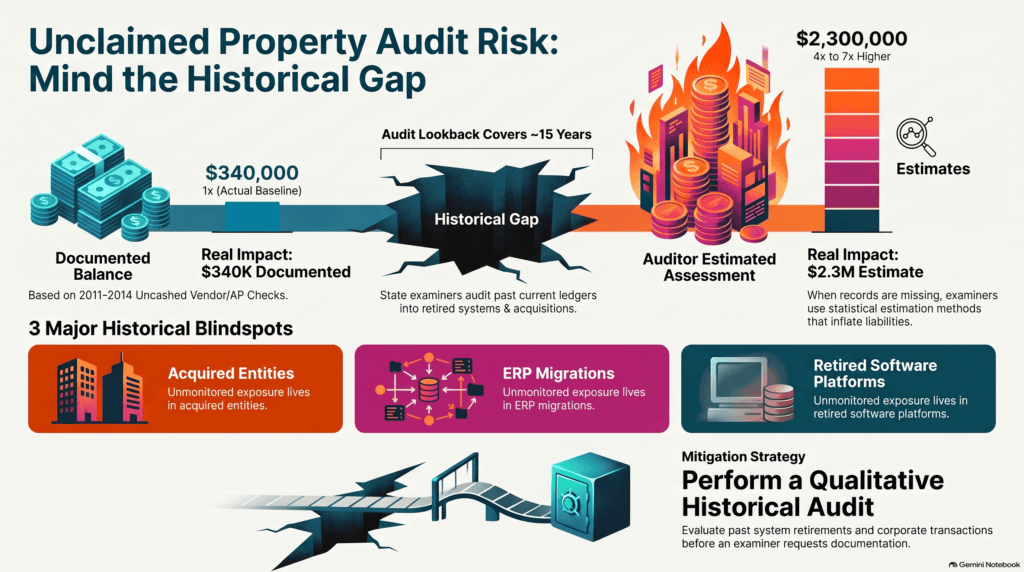
Here’s a real scenario. A company acquires a regional business in 2014. Only open items migrate into the parent ERP — closed transactions, old customer credits, and uncashed checks don’t make the cut. A 2026 Delaware audit covers 2011 through 2026. The examiner requests uncashed check data for 2011 through 2014. That data doesn’t exist in any current system.
Delaware estimates the liability for those four years at $2.3M using estimation techniques and industry averages. The documented balance — had the records existed — was $340,000.
That’s not an edge case. That’s how most acquisition-era exposure gets resolved.
The Gap Your Compliance Program Doesn’t Cover
The Three Layers of Unclaimed Property Audit Risk
Most finance teams think about unclaimed property risk in one layer: are we filing on time? The real risk has three layers.
The simple version: Your current compliance covers what you can see. It doesn’t cover what you’ve lost visibility into.
The technical layer: Every acquisition, every ERP migration, every divested entity, and every retired payroll system creates a historical record that may not exist in your current platform. Dormancy periods run, in general, 1 to 5 years depending on property type and state. A 15-year audit lookback crosses multiple system transitions for most large companies.
The business impact: When records are missing, examiners estimate. Estimation techniques and industry-average consistently runs 4 to 7 times higher than documented balances for the same period. That multiplier is the actual financial risk — not the face value of any one check or credit balance.
The question isn’t whether your compliance program is current. The question is whether it reaches back far enough to cover the history an auditor will ask about.
What to Do Before an Examiner Asks
Three categories of historical exposure catch most companies off guard:
- Acquired entities — any company you bought that ran its own AP, AR, or payroll before integration
- ERP migrations — closed-item data that didn’t transfer when you moved platforms
- Retired systems — AP, AR, payroll, T&E, or benefits platforms replaced in the last 15 years
None of these gaps appear in your current compliance dashboard. They exist in the space between what your software tracks and what a motivated examiner can reconstruct from public data, industry averages, and your own filing history.
However, they are findable — before an audit starts.
Get Ahead of the Gap
The companies that manage unclaimed property audit risk well aren’t the ones with the cleanest current books. They’re the ones that looked backward before an examiner did.
That means asking 15 qualitative questions about your company’s history — not pulling a general ledger. Questions about which systems you’ve retired. Which entities you’ve acquired. Which records didn’t survive a migration.
Ultimately, the companies that answer those questions first are the ones that get to bring documentation to the table instead of defending an estimate.
👉 Your Next Step
Before executing your next financial cycle, ledger cleanup, or data migration, determine exactly where your compliance risk stands.
- Free 5-Minute Qualitative Risk Assessment: Get an instant risk score with zero generic advice at EscheatAnalyzer.ai.
- Free 30-Minute Executive Consultation: Schedule a deep-dive session with our specialists at moyerosibodu.com.
❓ FREQUENTLY ASKED QUESTIONS
Unclaimed property audit risk is the chance that a state examiner finds unreported or under-reported owner obligations in your books — and then assesses liability, interest, and potential penalties as a result. For large companies, however, the risk isn’t usually the current general ledger. Instead, it’s the historical record: acquired entities, retired systems, and data that didn’t survive past migrations. Delaware alone conducts audits covering roughly 15 years of transactions. As a result, most Fortune 500 companies have at least one gap period in scope.
Delaware uses statistical methods tied to industry averages when a company can’t produce records for a given period. Specifically, the examiner takes your known filing history, applies an average rate for your industry, and then projects that rate backward across the missing years. In practice, estimated assessments run 4 to 7 times higher than what documented records would have produced for the same period. That multiplier is therefore why missing records are a financial risk, not just a compliance gap.
The highest-risk accounts are accounts receivable (customer credits, deposit balances, and unapplied cash), accounts payable, uncashed payroll and vendor checks. Because these property types have dormancy periods ranging from 1 to 7 years depending on the state, they tend to age out of active review in most AP and treasury workflows. In addition, suspense accounts and miscellaneous income are also high-risk — they’re where credit balances often go when no one wants to explain them.
It transfers — along with the entity. Specifically, when you acquire a company, you take on its unclaimed property history, whether or not that history appears in your current system. If the target’s AP, payroll, or AR records didn’t migrate cleanly into your ERP, those gaps consequently show up as missing periods in a later audit. Furthermore, Delaware and most states hold the successor entity responsible for the full lookback, regardless of what the purchase agreement says about liability carve-outs.
Yes — and the starting point is qualitative, not technical. The most useful first step is therefore a structured review of your company’s history: which systems you’ve retired, which entities you’ve acquired, and which records didn’t survive migrations. That review doesn’t require legal counsel or a full ledger pull. Instead, it requires honest answers to about 15 questions that most compliance software never asks. Once you know where the gaps likely sit, you can then decide whether to pursue a voluntary disclosure, engage outside help, or build a records reconstruction plan.
Yes. Specifically, EscheatAnalyzer.ai runs a free 5-minute qualitative assessment that asks the 15 historical questions your compliance software doesn’t. Results arrive instantly, with no cost required and no company name collected. As a result, the output identifies which areas of your company’s history carry the highest risk of undetected exposure — giving your team a baseline to work from before anyone pulls a general ledger or engages outside counsel.
