
What Delaware’s Unclaimed Property Examination Actually Looks Like
By Josiah S. Osibodu, CPA, CFE, Certified AI Consultant | 5-minute read
Most conversations about Delaware’s VDA program focus on the enrollment side — what you get if you act in time. Fewer explain what happens on the other side of that decision.
That’s the gap worth closing.
Delaware Unclaimed Property Examination: What Changes the Moment You’re Referred
When a company doesn’t enroll in Delaware’s VDA program during the open window, the State refers it for examination. That referral isn’t a warning letter or a second invitation. It’s the beginning of a state-controlled audit process, and several things change immediately.
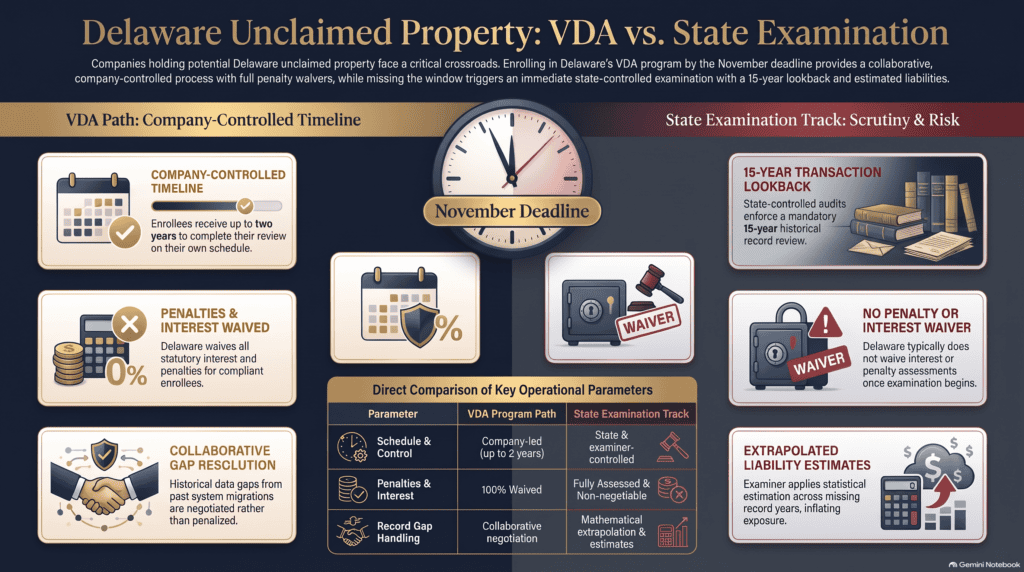
The lookback period extends to approximately 15 years. The examiner — not the company — sets the pace and scope. Penalties and interest accrue on identified liability, and Delaware does not typically waive either once examination begins.
But the factor most finance teams don’t anticipate is estimation.
How Delaware Estimates Liability When Records Are Incomplete
Delaware’s examination process includes the use of extrapolation techniques when a holder’s records are incomplete, unavailable, or in formats the examiner won’t accept. In practice, this means the State can calculate what it believes you owe based on available sample periods — and apply that calculation across years where you can’t produce records to the contrary.
This matters for a specific reason: most companies with unclaimed property exposure also have record gaps. ERP migrations, acquisitions, divestitures, system conversions — all of them create periods where historical transaction data exists in some form but not in a form that’s audit-ready.
In a VDA, those gaps are a problem to work through collaboratively. In an examination, they become the basis for an estimate.
The difference between what a company actually owes and what an examiner calculates it owes — using extrapolation across gap years — can be substantial. Not because the State is punitive, but because extrapolation by definition assumes a liability pattern that may not reflect your actual operations.
A Case Illustration: The Cost of Waiting
Consider a regional distributor with roughly $800M in annual revenue. They received Delaware’s VDA invitation during the most recent enrollment cycle. Their controller flagged the letter. Their legal team noted it. The consensus was that they should get their records in order before responding — that enrollment required a completed analysis.
It doesn’t. But by the time they understood that, the window had closed.
Delaware referred them for examination. The examiner requested 15 years of accounts receivable, accounts payable, payroll, and customer refund records. Four of those years predated an ERP migration. The data existed — but not in a format the examiner would accept without a conversion process that took three months to complete, during which the examination timeline continued to run.
For the gap years, Delaware applied an extrapolation method based on available sample data.
In scenarios like this, outside unclaimed property counsel routinely sees a significant gap between what an examination produces and what a completed VDA would have produced from the same underlying records. That gap isn’t driven by different facts — it’s driven by who controls the measurement. In a VDA, the holder works through record gaps collaboratively and negotiates the liability before it’s assessed. In an examination, the examiner fills those same gaps with extrapolation, and the resulting calculation doesn’t assume the best case. The method changes. The outcome follows.
This kind of outcome is not unusual. It’s a predictable result of a predictable process applied to companies with predictable record structures.
What the VDA Path Actually Requires
The enrollment-versus-completion distinction is the most important thing finance and legal teams can understand about the VDA process.
Enrollment is a commitment to participate — not a completed filing, not a finalized exposure calculation, not a ready set of records. A company can enroll with an incomplete picture of its liability and take the full two-year completion window to work through it. What it cannot do is enroll after the window closes.
That misreading — the assumption that enrollment requires readiness — is the most common reason companies end up on the examination track. Not carelessness. Not indifference. A reasonable but incorrect assumption about what the process requires before it starts.
What Examination Actually Involves, Week by Week
Once examination begins, the process moves on the examiner’s schedule. Initial document requests typically cover property types across the full lookback period: uncashed checks, accounts receivable credits, payroll, customer deposits, gift cards, ACH rejects/returns and any other balances subject to Delaware’s reporting rules.
Holders have a defined response window for each request. Missing a window doesn’t pause the examination — it creates a record of non-responsiveness the examiner can factor into scope decisions.
For companies managing parallel business operations, the bandwidth required to respond to an active examination is significant. Finance teams that are simultaneously closing quarters, managing various audits, or executing system changes often find examination response timelines extremely difficult to meet.
That is not an unusual situation. It is what examination looks like in practice.
Who Should Be Paying Attention Right Now
The current VDA enrollment window applies to companies that received Delaware’s outreach during this cycle. If your organization received that invitation and hasn’t acted, the window is still open for a few more days.
If you’re not certain whether your organization received the letter, that uncertainty is itself informative. Unclaimed property correspondence commonly routes to legal, treasury, or a registered agent — and doesn’t always reach the people who would recognize it as time-sensitive. Controllers and CFOs should verify directly.
The companies that enroll aren’t the ones with the cleanest records or the smallest exposure. They’re the ones that understood the difference between what enrollment requires and what examination produces — and made the decision while they still could.
| 👉 Your Next Steps: Before executing your next financial cycle, ledger cleanup, or data migration, determine exactly where your compliance risk stands. 🔍 Free 5-Minute Qualitative Risk Assessment: Get an instant risk score with zero generic advice at EscheatAnalyzer.ai. 📞 Free 60-Minute Executive Consultation: Schedule a deep-dive session with our specialists at moyerosibodu.com. |
❓ Frequently Asked Questions
A Delaware unclaimed property examination is typically triggered when a company either fails to respond to a VDA invitation during the open enrollment window or is identified through the State’s proactive compliance screening. Once referred for examination, the process is state-controlled: the examiner is assigned, the lookback period is set, and the holder works within the examiner’s timeline — not its own. The examination is not a negotiated process in the way a VDA is.
Delaware’s examination lookback period is approximately 15 years of transaction history. That means accounts receivable, accounts payable, payroll records, customer refunds, uncashed checks, ACH returns/rejects, unredeemed gift card balances, and other property types across a 15-year window are in scope. For companies with ERP migrations, acquisitions, or system conversions within that period, assembling a complete and examiner-ready record set is often a significant undertaking — one that takes place under the examiner’s timeline, not the company’s.
Sometimes records are incomplete. Other times, they exist in formats the examiner won’t accept. In either case, Delaware can apply extrapolation techniques to estimate liability. Specifically, the State uses available sample periods to project exposure across gap years. That extrapolation doesn’t assume the best case for the company. Instead, it applies a method designed to produce a defensible estimate for the State. If a company can’t rebut that estimate with documentation, it’s bound by the result. The contrast with a VDA is significant. In a VDA, record gaps are worked through collaboratively with Delaware. In an examination, those same gaps become the input for an estimate the company doesn’t control.
No. Penalty and interest waivers are a feature of the VDA — not the examination track. Once Delaware refers a company for examination, interest begins accruing on the identified liability. If the examiner applies extrapolation, interest accrues on the estimated liability as well. Delaware does not typically waive either. This matters more than it might initially seem. For companies with multi-year exposure across multiple property types, interest alone can be substantial. It accrues separately from — and in addition to — the principal liability. So the total assessment often exceeds what the underlying records would have produced on their own. That’s a direct consequence of the examination track. It’s also one of the clearest financial arguments for enrolling in the VDA while the window is open.
The difference isn’t always in the underlying exposure — it’s in how that exposure is measured and resolved. In a VDA, the holder controls the scope, works collaboratively with Delaware on record interpretation, and negotiates the liability before it’s assessed. In an examination, the examiner controls scope, gaps are filled by estimation, and penalties and interest are added to whatever is identified. A company with the same underlying liability can face a materially different outcome depending entirely on which process applies.
The fastest starting point is a qualitative risk assessment — one that evaluates your company’s exposure profile without requiring a ledger pull. EscheatAnalyzer.ai walks through 15 questions about your operations, transaction history, and compliance posture and produces an instant risk score. Results arrive instantly, with no cost required and no company name collected. It won’t replace a formal analysis, but it will tell you whether your exposure profile warrants immediate action — which is exactly the question to answer before the enrollment window closes.
